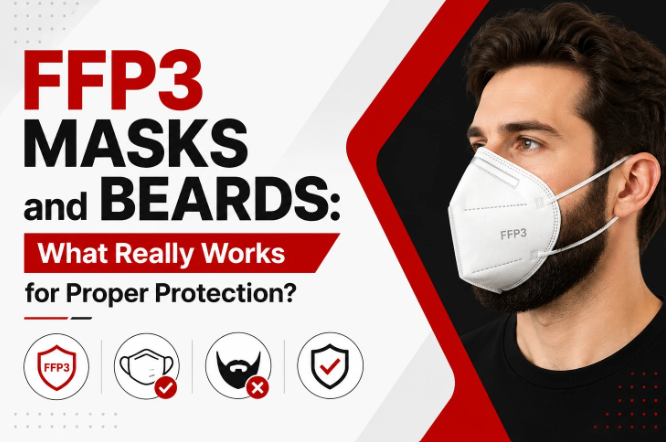
Wearing a mask is half story when it comes to respiratory protection. The actual protection lies in how well protective masks fit. This can become a major issue for workers with beards. It is a common assumption that a higher grade of mask like an FFP3 face mask guarantees safety. The fact is, even the best protective mask is unable to create a proper seal for bearded workers.
It is crucial to check the impact of facial hair on the mask performance. Commonly in the UK workplaces, compliance, fit testing, and safety standards are greatly observed. It is important to select the best protective mask to guarantee site safety or a worker’s health.
Can You Wear an FFP3 Mask with a Beard?
Mostly, FFP3 facemasks are tight-fitting respirators that highly rely on a tight seal against the skin to ensure a full level of protection. It can prevent the mask from sealing if you have a beard or even a short stubble. When the seal is broken, unfiltered air enters through small gaps and reduces the mask’s safety.
In the UK, tight fitting respirators like an FFP3 mask require fit testing under HSE guidance. The wearer is unlikely to pass the fit test if their facial hair remains in the sealing area. This results in noncompliance or passed safety test of the protective mask. Based on its final compliance results, the FFP3 mask is used in workplace settings where respiratory protection is important.
Why Facial Hair Affects FFP3 Mask Performance
FFP3 dust masks enable a high level of protection when it forms a tight seal against the skin. The mask is made in a way that all breaths are filtered through its filter before they get into your lungs and cause harm. In case of gaps at the edges, raw air may gain access directly and make the mask ineffective. Small leaks are enough to breach protection, especially in a high-risk setting where the levels of exposure are high.
Practical Solutions for Bearded Workers
In case you need respiratory protection at the highest level and have some facial hair, you can find workable solutions, but not all of them are equal. The trick is to find a solution that will preserve certified protection without losing safety.
Clean-Shaven for Maximum Protection
The best solution is to shave the place where the mask sticks to the face. Smooth skin enables the respirator to create a tight seal. This enables air breathed into flow through the filter. That is why clean-shaven policies are in place in a number of working environments where FFP3 is necessary. It is not about what it looks like, but ensuring the protective mask works as designed.
Beard-Friendly Respiratory Alternatives
In case of no shaving, the safest solution would be a respiratory system that is not based on a tight facial seal. Such alternatives are common in medical care, labs, and industries where saving is not possible.
- Powered Air Purifying Respirators (PAPR): This is a system that involves the use of a battery-operated unit to draw air outside into filters and then directs clean air into a hood or face mask.
- Loose-fitting hoods and helmets: They can be used by users with beards, still offering high protection as it doesn’t directly cover the face.
How to Select the Right Respiratory Protection If You Have a Beard
- It is important that you are honest about your workplace environment and the intensity of exposure that you encounter before choosing your respiratory protection. Since a higher risk environment requires genuinely effective respiratory protection rather than one that is merely alleged to be effective.
- One should keep in mind that full-face respirator and tight-fitting FFP3 masks are created in a way that it perfectly fits on the skin, and it is guaranteed that even the smallest stubble will cover at least half the sealing point; thus, a beard will be a serious issue with tight-fitting masks as well.
- In most cases, to achieve maximum protection and compliance, shaving is the easiest and surest approach to FFP3 protection, especially when it is legally required in your job.
- When it is not possible to shave, due to personal, cultural, or religious reasons, powered air purifying respirators (PAPR) or loose-fitting hoods and helmets would be a more secure choice, since they are not based on a tight facial fit.
- Beard covers can help to look tidy (facial hair), but cannot provide an airtight seal and cannot be used to ensure appropriate respiratory protection.
- In the UK, HSE regulations demand tight-fitting respirator fit testing and consequently, in the event that you fail a fit test because of facial hair, the mask in question should not be viewed as effective protection.
- You must always discuss with your employer, health and safety officer to ensure that the respiratory protection that has been selected is the one that fits the work risk assessment and the legal provisions.
- Most importantly, convenience should not be a priority over your respiratory health. Because correct protective measure is important, whether it is a half face mask or a full face respirator that actually protects you.
Workplace Compliance and Legal Requirements (UK Focus)
In the UK, respiratory protection becomes mandatory when workers come in contact with hazardous substances at the workplace.
- The requirements of the Control of Substances Hazardous to Health (COSHH) regulations 2002 include the requirement that employers carry out the risk assessment and offer the appropriate respiratory protective equipment (RPE) where the risks are uncontrollable.
- Health and Safety Executive (HSE) mandate that all tight-fitting respirators such as FFP3 face masks should be tested during face fits. This assists in the provision of the required degree of protection by masks.
- In case there is facial hair that extends to the sealing mask area, the person is not likely to pass the fit test. This assists in making sure the protection that is being offered by masks is as desired.
- In case the facial hair is positioned over the sealing space of the mask, then most probably the wearer will fail the fit test. This indicates the protective mask is not effective or compliant.
- Where shaving is not possible, loose fitting powered air purifying respirators (PAPR) can be used. It is because it doesn’t rely on a tight facial seal.
- Employers must also provide training, proper storage, maintenance and supervision to ensure RPE is used correctly.
Conclusion
There is no room for assumptions while considering respiratory protection. It is important to stay updated that facial hair affects the performance of tight-fitting masks. Whether it is modifying grooming policies, using other equipment, or re-examining the risks in the workplace, it should always be the effective protection in mind. Safety equipment can only work at the end of the day when it is befitting to the individual who wears it.
An informed approach is what will be sure to make the protection not a mere conception but actually effective under the conditions of actual working conditions. By selecting an appropriate solution from Respirators Shop, organizations can preserve compliance, enhance safety culture, and, above all, defend respiratory health in the long term.
FAQs
Is a full face respirator suitable to individuals with beards?
Even a complete face respirator depends on a close fit to the skin. When hair grows along the sealing edge, it may be counterproductive to a fit of the mask and protection. The seal might not pass the test of a clean shave or offer good protection without a clean shave on the part of the wearer.
Will bearded workers be covered with disposable dust masks?
Tight-fitting respirators and disposable dust masks like the FFP1, FFP2, or FFP3 should be in direct contact with the skin. When a person has face hair on the seal region, the effectiveness of the mask may decline considerably. In the majority of regulated work environments, this would not be considered adequate protection.
Does face-fit testing of FFP3 masks is important?
According to the Health and Safety Executive (HSE), it is important to perform a face fit test for any tight-fitting respirator like FFP3 mask. This helps in ensuring that the mask is a good seal and it provides the desired amount of protection. The mask cannot be depended upon to work in the hazardous environments unless successful fit test is carried out.
Which is the safest mask for bearded workers?
Powered air purifying respirator (PAPR) and a helmet or hood are safest respirators for bearded workers. These systems are also not dependent on a close seal around the face hence can be used by individuals with beards at the same time with high protection.
Can workers with facial hairs wear half-face respirator masks?
Half-face respirators rely on a tight fit around the mouth and nose. In case facial hair comes in between such a seal, then protection may be lost. They need fit testing, like other tight-fitting masks, and are usually not classified as safe to use with facial hair adjacent to the sealing area.